

How To Register Your Australian Shepherd In Asca
 The Australian Ancient Flag | |
 1st row: Windradyne, David Gulpilil, Albert Namatjira, David Unaipon, Mandawuy Yunupingu second row: Truganini, Yagan, Geoffrey Gurrumul Yunupingu, Bennelong, Robert Tudawali | |
| Full population | |
|---|---|
| 759,705 (2016)[i] 3.one% of Commonwealth of australia'southward population | |
| Regions with significant populations | |
| Northern Territory | 30.three% |
| Tasmania | five.5% |
| Queensland | four.six% |
| Western Commonwealth of australia | 3.9% |
| New South Wales | 3.iv% |
| South Australia | 2.v% |
| Australian Capital letter Territory | 1.9% |
| Victoria | 0.9% |
| Languages | |
| Several hundred Australian Aboriginal languages, many no longer spoken, Australian English language, Australian Ancient English, Kriol | |
| Religion | |
| Majority Christian (mainly Anglican and Catholic),[2] minority no religious affiliation,[ii] and minority Islam[three] also pocket-sized numbers of other religions, various local ethnic religions grounded in Australian Aboriginal mythology | |
| Related ethnic groups | |
| Torres Strait Islanders, Aboriginal Tasmanians, Papuans | |

Aboriginal Australians are the various Indigenous peoples of the Australian mainland and many of its islands, such as Tasmania, Fraser Isle, Hinchinbrook Island, the Tiwi Islands, and Groote Eylandt, just excluding the Torres Strait Islands. The term Ethnic Australians refers to Aboriginal Australians and Torres Strait Islanders collectively. It is by and large used when both groups are included in the topic existence addressed. Torres Strait Islanders are ethnically and culturally distinct, despite extensive cultural exchange with some of the Ancient groups. The Torres Strait Islands are mostly part of Queensland but have a split up governmental status.
Aboriginal Australians comprise many distinct peoples who have developed across Australia for over l,000 years. These peoples accept a broadly shared, though circuitous, genetic history, only merely in the terminal 200 years have they been defined and started to self-place as a unmarried group. Australian Ancient identity has changed over time and place, with family lineage, self-identification and customs acceptance all being of varying importance.
In the past, Aboriginal Australians lived over big sections of the continental shelf and were isolated on many of the smaller offshore islands and Tasmania when the land was inundated at the get-go of the Holocene inter-glacial flow, almost 11,700 years ago. Studies regarding the genetic make-up of Ancient groups are still ongoing, only prove has suggested that they have genetic inheritance from ancient Asian merely non more modern peoples, share some similarities with Papuans, but have been isolated from Southeast Asia for a very long time. Earlier extensive European settlement, there were over 250 Ancient languages.[4] [5]
In the 2016 Australian Census, Ethnic Australians comprised 3.3% of Australia'south population, with 91% of these identifying equally Ancient but, five% Torres Strait Islander, and iv% both. They also live throughout the globe every bit office of the Australian diaspora.
Most Aboriginal people speak English, with Aboriginal phrases and words being added to create Australian Aboriginal English (which also has a tangible influence of Aboriginal languages in the phonology and grammatical structure).
Aboriginal people, along with Torres Strait Islander people, have a number of health and economic deprivations in comparing with the wider Australian community.
Origins

Ancient dancers in 1981


The ancestors of present-twenty-four hour period Aboriginal Australian people migrated from South Eastern asia by sea during the Pleistocene epoch and lived over large sections of the Australian continental shelf when the body of water levels were lower and Australia, Tasmania and New Guinea were office of the same landmass, known every bit Sahul. Equally sea levels rose, the people on the Australian mainland and nearby islands became increasingly isolated, and some were isolated on Tasmania and some of the smaller offshore islands when the land was inundated at the start of the Holocene, the inter-glacial period which started about eleven,700 years ago and persists today.[7] Prehistorians believe that it would have been difficult for Aboriginal people to take originated purely from mainland Asia, and non plenty numbers would accept made it to Commonwealth of australia and surrounding islands to fulfil the beginning of the population that we take seen in the final century. This is why it is commonly believed that well-nigh Aboriginal Australians have originated from South East asia, and if this is the case, Australian Aboriginals would take been amongst the start in the world to have completed successful sea voyages.[8]
A 2017 paper in Nature evaluated artefacts in Kakadu and concluded "Human occupation began around 65,000 years ago".[9]
A 2021 study by researchers at the Australian Research Quango Centre of Excellence for Australian Biodiversity and Heritage has mapped the probable migration routes of the peoples as they moved across the Australian continent to its southern reaches of what is now Tasmania, then part of the mainland. The modelling is based on data from archaeologists, anthropologists, ecologists, geneticists, climatologists, geomorphologists, and hydrologists, and it is intended to compare the modelling with the oral histories of Aboriginal peoples, including Dreaming stories, as well as Australian stone fine art and linguistic features of the many Ancient languages. The routes, dubbed "superhighways" past the authors, are similar to electric current highways and stock routes in Commonwealth of australia. Lynette Russell of Monash University sees the new model as a starting point for collaboration with Aboriginal people to assistance uncover their history. The new models suggest that the first people may have start landed in the Kimberley region in what is at present Western Australia most 60,000 years agone, and had settled beyond the continent within half dozen,000 years.[10] [11]
Genetics
Studies regarding the genetic makeup of Aboriginal Australian people are nonetheless ongoing, but evidence has suggested that they have genetic inheritance from aboriginal Eurasian merely not more than modern peoples, share some similarities with Papuans, but accept been isolated from Southeast Asia for a very long time.
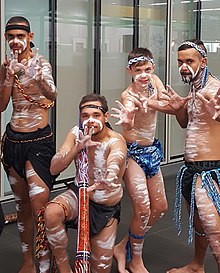
Noongar traditional dancers, Perth, Australia
Aboriginal people are genetically most similar to the indigenous populations of Papua New Guinea, and more distantly related to groups from E Indonesia. They are quite distinct from the indigenous populations of Borneo and Malaysia, sharing relatively little genomic information as compared to the groups from Papua New Guinea and Republic of indonesia. This indicates that Commonwealth of australia was isolated for a long time from the rest of Southeast Asia, and remained untouched by migrations and population expansions into that surface area.[12]
In a 2001 study, blood samples were nerveless from some Warlpiri people in the Northern Territory, to written report their genetic makeup (which is not representative of all Aboriginal peoples in Australia). The study concluded that the Warlpiri are descended from ancient Asians whose Deoxyribonucleic acid is nonetheless somewhat present in Southeastern Asian groups, although greatly diminished. The Warlpiri Dna lacks sure information institute in modernistic Asian genomes, and carries information not found in other genomes, reinforcing the idea of ancient Aboriginal isolation.[12]
In a 2011 genetic study by Morten Rasmussen et al., researchers took a DNA sample from an early-20th-century lock of an Aboriginal person's hair. They found that the ancestors of the Aboriginal Australian population split off from other Eurasians between 62,000 and 75,000 BP, whereas the European and Asian populations split only 25,000 to 38,000 years BP, indicating an extended period of Aboriginal genetic isolation. These Aboriginal ancestors probably migrated into South Asia and then into Australia, where they stayed, with the result that, outside of Africa, the Aboriginal peoples take occupied the aforementioned territory continuously longer than any other human populations. These findings suggest that modern Aboriginal Australians are the direct descendants of migrants who left Africa up to 75,000 years ago.[13] [fourteen] [15] This finding is uniform with earlier archaeological finds of human remains nearly Lake Mungo that date to approximately 40,000 years ago.[ citation needed ] The idea of the "oldest continuous culture" is based on the geographical isolation of the Aboriginal peoples, with little or no interaction with outside cultures before some contact with Makassan fishermen and Dutch explorers upward to 500 years BP.[16]
The Rasmussen study also found evidence that Ancient peoples carry some of the genes associated with the Denisovans (a species of man related to simply distinct from Neanderthals) of Asia; the study suggests that at that place is an increase in allele sharing between the Denisovan and Aboriginal Australian genomes, compared to other Eurasians and to Africans. Examining DNA from a finger bone excavated in Siberia, researchers ended that the Denisovans migrated from Siberia to tropical parts of Asia and that they interbred with modernistic humans in South-East asia 44,000 years BP, before Australia separated from New Guinea approximately xi,700 years BP. They contributed Dna to Ancient Australians along with present-twenty-four hour period New Guineans and an indigenous tribe in the Philippines known equally Mamanwa. This written report makes Aboriginal Australians i of the oldest living populations in the world and possibly the oldest outside of Africa, confirming they may also have the oldest continuous culture on the planet.[17]
A 2016 study at the University of Cambridge past Christopher Klein et al. reported that Papuan and Aboriginal peoples developed distinct markers around 58,000 years BP that distinguished them from the original out-of-Africa migration effectually 72,000 years BP, pointing to a single migration henceforth untouched past other groups. The study suggests that it was about l,000 years ago that these peoples reached Sahul (the supercontinent consisting of present-mean solar day Australia and its islands and New Guinea). The sea levels rose and isolated Australia (and Tasmania) about 10,000 years ago, just Ancient Australians and Papuans diverged from each other genetically before, about 37,000 years BP, perhaps because the remaining land bridge was impassable, and it was this isolation which makes it the world's oldest culture. The study also found evidence of an unknown hominin group, distantly related to Denisovans, with whom the Ancient and Papuan ancestors must accept interbred, leaving a trace of about iv% in virtually Aboriginal Australians' genome. There is, all the same, huge genetic diversity among Aboriginal Australians based on geographical distribution.[xviii]

PCA calculated on nowadays-day and ancient individuals from eastern Eurasia and Oceania. PC1 (23,viii%) distinguish East-Eurasians and Australo-Melanesians, while PC2 (6,3%) differentiates East-Eurasians along a North to Due south cline.
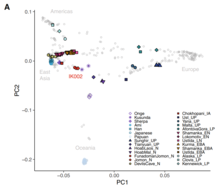
Principal component analysis (PCA) of ancient and modern mean solar day individuals from worldwide populations. Oceanians (Aboriginal Australians and Papuans) are well-nigh differentiated from both East-Eurasians and Due west-Eurasians.
Contempo genetic bear witness suggests that Australo-Papuans (or Australo-Melanesians) formed from two distinct lineages, which merged in the Oceania at about 37,000BC. Co-ordinate to the genomic information, as well as archeologic evidence, Australo-Papuans (such as the indigenous people of New Republic of guinea and Ancient Australians) formed from an basal lineage, closer to Africans, sometimes referred to as S-Eurasian, and an East-Eurasian lineage (represented by Basal-Eastward Asians, such every bit the Andamanese (Onge) or Tianyuan man from modern 24-hour interval Prc). Australo-Papuans therefore grade an outgroup to other Eurasians (West-Eurasians and East-Eurasians) and divide from them between 55,000BC to 61,000BC, although beingness shifted towards East-Eurasian populations. A Holocene hunter-gatherer sample (Leang_Panninge) from South Sulawesi was found to be genetically in between East-Eurasians and Australo-Papuans. The sample could be modeled as ~50% Papuan-related and ~50% Basal-E Asian-related (Andamanese Onge or Tianyuan). The authors concluded that Basal-East Asian ancestry was far more widespread and the peopling of Insular Southeast Asia and Oceania was more complex than previously predictable.[19] [20] [21]
Changes around 4,000 years agone
The dingo reached Australia nearly 4,000 years ago, and around the same fourth dimension there were changes in language (with the Pama-Nyungan linguistic communication family spreading over almost of the mainland), and in stone tool applied science, with the use of smaller tools. Human being contact has thus been inferred, and genetic information of two kinds have been proposed to support a factor flow from India to Australia: firstly, signs of Due south Asian components in Aboriginal Australian genomes, reported on the footing of genome-broad SNP data; and secondly, the existence of a Y chromosome (male person) lineage, designated haplogroup C∗, with the most recent common ancestor around 5,000 years ago.[22] The first type of evidence comes from a 2013 study past the Max Planck Plant for Evolutionary Anthropology using large-calibration genotyping information from a puddle of Aboriginal Australians, New Guineans, island Southeast Asians, and Indians. It institute that the New Guinea and Mamanwa (Philippines area) groups diverged from the Aboriginal about 36,000 years agone (and supporting bear witness that these populations are descended from migrants taking an early "southern route" out of Africa, before other groups in the area), and also that the Indian and Australian populations mixed well earlier European contact, with this gene catamenia occurring during the Holocene (c. 4,200 years ago).[23] The researchers had two theories for this: either some Indians had contact with people in Indonesia who eventually transferred those Indian genes to Aboriginal Australians, or that a group of Indians migrated all the way from India to Australia and intermingled with the locals straight.[24] [25]
However, a 2016 study in Current Biology past Anders Bergström et al. excluded the Y chromosome as providing evidence for recent gene flow from India into Australia. The study authors sequenced thirteen Aboriginal Australian Y chromosomes using recent advances in gene sequencing technology, investigating their divergence times from Y chromosomes in other continents, including comparing the haplogroup C chromosomes. They found a divergence time of well-nigh 54,100 years between the Sahul C chromosome and its closest relative C5, too every bit nigh 54,300 years between haplogroups K*/M and their closest haplogroups R and Q. The deep divergence time of l,000+ years with the South Asian chromosome and "the fact that the Aboriginal Australian Cs share a more recent common ancestor with Papuan Cs" excludes any recent genetic contact.[22]
The 2016 study's authors concluded that, although this does non disprove the presence of whatsoever Holocene gene flow or non-genetic influences from Southern asia at that time, and the appearance of the dingo does provide stiff bear witness for external contacts, the evidence overall is consistent with a complete lack of gene flow, and points to ethnic origins for the technological and linguistic changes. They attributed the disparity betwixt their results and previous findings to improvements in engineering; none of the other studies had utilized consummate Y chromosome sequencing, which has the highest precision. For example, use of a ten Y STRs method has been shown to massively underestimate deviation times. Gene menstruum beyond the island-dotted 150-kilometre-wide (93 mi) Torres Strait, is both geographically plausible and demonstrated by the data, although at this betoken it could not be determined from this study when within the final ten,000 years it may have occurred – newer belittling techniques have the potential to address such questions.[22]
Bergstrom'due south 2018 doctoral thesis looking at the population of Sahul suggests that other than relatively recent admixture, the populations of the region appear to have been genetically independent from the remainder of the world since their departure about 50,000 years ago. He writes "There is no show for S Asian gene menses to Australia .... Despite Sahul being a single connected landmass until [eight,000 years ago], dissimilar groups across Australia are nigh equally related to Papuans, and vice versa, and the two appear to have separated genetically already [most 30,000 years ago]".[26]
Environmental adaptations
Aboriginal Australians possess inherited abilities to stand up a wide range of environmental temperatures in various means. A report in 1958 comparing cold adaptation in the desert-dwelling house Pitjantjatjara people compared with a group of European people showed that the cooling accommodation of the Aboriginal group differed from that of the white people, and that they were able to slumber more soundly through a cold desert night.[27] A 2014 Cambridge Academy study found that a beneficial mutation in two genes which regulate thyroxine, a hormone involved in regulating body metabolism, helps to regulate body temperature in response to fever. The outcome of this is that the desert people are able to accept a higher body temperature without accelerating the activity of the whole of the body, which can be especially detrimental in babyhood diseases. This helps protect people to survive the side-effects of infection.[28] [29]

An Ancient encampment nigh the Adelaide foothills in an 1854 painting by Alexander Schramm
Location and demographics
Aboriginal people have lived for tens of thousands of years on the continent of Australia, through its various changes in landmass. The area inside Australia'southward borders today includes the islands of Tasmania, Fraser Island, Hinchinbrook Isle,[30] the Tiwi Islands and Groote Eylandt. Indigenous people of the Torres Strait Islands, notwithstanding, are not Aboriginal.[31] [32] [33] [34]
In the 2016 Australian Demography, Indigenous Australians comprised 3.3% of Australia's population, with 91% of these identifying every bit Aboriginal merely, five% Torres Strait Islander, and 4% both.[35]
Aboriginal people as well live throughout the world equally role of the Australian diaspora.[ citation needed ]
Languages
Most Aboriginal people speak English,[36] with Aboriginal phrases and words being added to create Australian Ancient English language (which besides has a tangible influence of Aboriginal languages in the phonology and grammatical construction).[37] Some Aboriginal people, especially those living in remote areas, are multi-lingual.[36] Many of the original 250–400 Ancient languages (more than than 250 languages and most 800 dialectal varieties on the continent) are endangered or extinct,[38] although some efforts are beingness made at linguistic communication revival for some. As of 2016, only xiii traditional Indigenous languages were still beingness acquired by children,[39] and nearly another 100 spoken by older generations only.[38]
Aboriginal Australian peoples
Dispersing across the Australian continent over time, the aboriginal people expanded and differentiated into distinct groups, each with its ain language and culture.[40] More than 400 distinct Australian Ancient peoples take been identified, distinguished by names designating their ancestral languages, dialects, or distinctive speech patterns.[41] According to noted anthropologist, archeologist and sociologist Harry Lourandos, historically, these groups lived in three main cultural areas, the Northern, Southern, and Central cultural areas. The Northern and Southern areas, having richer natural marine and woodland resources, were more densely populated than the Central area.[forty]

Geographically-based names
There are diverse other names from Australian Aboriginal languages commonly used to place groups based on geography, known every bit demonyms, including:
- Anangu in northern Southward Australia, and neighbouring parts of Western Australia and Northern Territory
- Goorie (variant pronunciation and spelling of Koori) in South East Queensland and some parts of northern New South Wales
- Koori (or Koorie) in New South Wales and Victoria (Aboriginal Victorians)
- Murri in southern Queensland
- Nunga in southern South Australia
- Noongar in southern Western Australia
- Palawah (or Pallawah) in Tasmania
- Tiwi on Tiwi Islands off Arnhem Land (NT)
A few examples of sub-groups
Other group names are based on the language grouping or specific dialect spoken. These also coincide with geographical regions of varying sizes. A few examples are:
- Anindilyakwa on Groote Eylandt (off Arnhem State), NT
- Arrernte in central Commonwealth of australia
- Aranda people of central Commonwealth of australia[8]
- Bininj in Western Arnhem Land (NT)[42]
- Gunggari in southward-west Queensland[43]
- Muruwari people in New South Wales
- Luritja (Kukatja), an Anangu sub-grouping based on language
- Ngunnawal in the Australian Upper-case letter Territory and surrounding areas of New South Wales
- Pitjantjatjara, an Anangu sub-grouping based on language
- Wangai in the Western Australian Goldfields
- Warlpiri (Yapa) in western fundamental Northern Territory
- Yamatji in cardinal Western Australia
- Yolngu in eastern Arnhem Land (NT)
Difficulties defining groups
Nonetheless these lists are neither exhaustive nor definitive, and there are overlaps. Dissimilar approaches have been taken by non-Aboriginal scholars in trying to empathise and define Aboriginal culture and societies, some focusing on the micro-level (tribe, association, etc.), and others on shared languages and cultural practices spread over large regions defined by ecological factors. Anthropologists accept encountered many difficulties in trying to define what constitutes an Ancient people/community/group/tribe, allow alone naming them. Knowledge of pre-colonial Aboriginal cultures and societal groupings is still largely dependent on the observers' interpretations, which were filtered through colonial means of viewing societies.[44]
Some Ancient peoples identify as ane of several saltwater, freshwater, rainforest or desert peoples.
Ancient identity
The term Aboriginal Australians includes many distinct peoples who have adult across Australia for over 50,000 years.[9] [45] These peoples have a broadly shared, though circuitous, genetic history,[46] [25] but information technology is but in the concluding 2 hundred years that they have been divers and started to self-identify equally a unmarried group, socio-politically.[47] [48] While some preferred the term Aborigine to Ancient in the past, as the latter was seen to have more than straight discriminatory legal origins,[47] utilise of the term Aborigine has declined in recent decades, equally many consider the term an offensive and racist hangover from Australia'southward colonial era.[49] [l]
The definition of the term Aboriginal has changed over time and place, with the importance of family lineage, self-identification and customs acceptance all being of varying importance.[51] [52] [53]
The term Indigenous Australians refers to Aboriginal Australians as well as Torres Strait Islander peoples, and the term is conventionally just used when both groups are included in the topic being addressed, or by self-identification past a person as Indigenous. (Torres Strait Islanders are ethnically and culturally distinct,[54] despite extensive cultural commutation with some of the Aboriginal groups,[55] and the Torres Strait Islands are mostly role of Queensland only have a separate governmental status.) Some Aboriginal people object to being labelled Ethnic, as an artificial and denialist term.[48]
Culture and beliefs
Australian Ethnic people have beliefs unique to each mob (tribe) and have a stiff connection to the land.[56] [57] Contemporary Indigenous Australian beliefs are a complex mixture, varying by region and individual beyond the continent.[58] They are shaped past traditional behavior, the disruption of colonisation, religions brought to the continent by Europeans, and contemporary issues.[58] [59] [60] Traditional cultural beliefs are passed down and shared by dancing, stories, songlines, and art - specially Papunya Tula (dot painting) - collectively telling the story of creation known as The Dreamtime.[61] [56] Additionally, traditional healers were too custodians of of import Dreaming stories as well equally their medical roles (for case the Ngangkari in the Western desert).[62] Some cadre structures and themes are shared across the continent with details and boosted elements varying between language and cultural groups.[58] For example, in The Dreamtime of most regions, a spirit creates the earth so tells the humans to treat the animals and the earth in a style which is respectful to country. In Northern Territory this is commonly said to be a huge snake or snakes that weaved its way through the earth and sky making the mountains and oceans. Only in other places the spirits who created the world are known every bit wandjina pelting and water spirits. Major ancestral spirits include the Rainbow Snake, Baiame, Dirawong and Bunjil. Similarly, the Arrernte people of central Commonwealth of australia believed that humanity originated from great superhuman ancestors who brought the sunday, wind and rain as a event of breaking through the surface of the Earth when waking from their sleep.[eight]
Health and disadvantage
Aboriginal Australians, along with Torres Strait Islander people, take a number of health and economic deprivations in comparison with the wider Australian community.[63] [64]
Due to the aforementioned disadvantage, Aboriginal Australian communities feel a college charge per unit of suicide, as compared to not-indigenous communities. These problems stalk from a diverseness of dissimilar causes unique to indigenous communities, such as historical trauma,[65] socioeconomic disadvantage, and decreased admission to education and health care.[66] As well, this problem largely affects indigenous youth, as many indigenous youth may feel asunder from their civilization.[67]
To combat the increased suicide rate, many researchers take suggested that the inclusion of more than cultural aspects into suicide prevention programs would help to combat mental health problems within the customs. Past studies have found that many indigenous leaders and community members, do in fact, want more culturally-aware health care programs.[68] Similarly, culturally-relative programs targeting ethnic youth have actively challenged suicide ideation among younger ethnic populations, with many social and emotional wellbeing programs using cultural information to provide coping mechanisms and improving mental wellness.[69] [70]
Viability of remote communities

Historical prototype of Ancient Australian women and children, Maloga, New South Wales around 1900 (in European dress)
The outstation motility of the 1970s and 1980s, when Aboriginal people moved to tiny remote settlements on traditional land, brought health benefits,[71] [72] merely funding them proved expensive, training and employment opportunies were non provided in many cases, and support from governments dwindled in the 2000s, peculiarly in the era of the Howard regime.[73] [74] [75]
Indigenous communities in remote Commonwealth of australia are often small, isolated towns with basic facilities, on traditionally-owned land. These communities have between 20 and 300 inhabitants and are often airtight to outsiders for cultural reasons. The long-term viability and resilience of Aboriginal communities in desert areas has been discussed by scholars and policy-makers. A 2007 report by the CSIRO stressed the importance of taking a demand-driven approach to services in desert settlements, and concluded that "if top-downwardly solutions continue to exist imposed without appreciating the central drivers of settlement in desert regions, then those solutions will continue to be partial, and ineffective in the long term".[76]
Come across besides
- Aboriginal Center for the Performing Arts (ACPA)
- Ancient cultures of Western Commonwealth of australia
- Aboriginal South Australians
- Australian Aboriginal culture
- Australian Aboriginal kinship
- Australian Aboriginal religion and mythology
- Climate alter in Australia
- Indigenous Australian fine art
- Indigenous Australian music
- First Nations Media Australia
- Indigenous land rights in Australia
- List of Aboriginal missions in New Southward Wales
- List of Indigenous Australian firsts
- List of massacres of Indigenous Australians
- Lists of Indigenous Australians
- National Ancient & Torres Strait Islander Art Award
- Native title in Australia
- Stolen Generations
- Supply Nation
References
- ^ "Estimates of Aboriginal and Torres Strait Islander Australians". Australian Agency of Statistics. June 2016. Retrieved 8 Nov 2018.
- ^ a b "4713.0 – Population Characteristics, Ancient and Torres Strait Islander Australians". Australian Bureau of Statistics. 4 May 2010.
- ^ "The Aboriginal Muslims in Australia everyone should exist proud of". OnePath Network. 28 February 2017.
- ^ "Languages of Aboriginal And Torres Strait Islander Peoples – a Uniquely Australian Heritage". Australian Bureau of Statistics. 23 November 2012. Retrieved 26 May 2015.
- ^ "Customs, identity, wellbeing: The study of the Second National Indigenous Languages Survey". AIATSIS. 2014. Archived from the original on 24 April 2015. Retrieved 18 May 2015.
- ^ Graves, Randin. "Yolngu are People 2: They're non Clip Fine art". Yidaki History . Retrieved 30 August 2020.
- ^ Rebe Taylor (2002). Unearthed: The Aboriginal Tasmanians of Kangaroo Island. Kent Town: Wakefield Press. ISBN978-1-86254-552-6.
- ^ a b c Read, Peter; Broome, Richard (1982). "Ancient Australians". Labour History (43): 125–126. doi:10.2307/27508560. ISSN 0023-6942. JSTOR 27508560.
- ^ a b Clarkson, Chris; Jacobs, Zenobia; et al. (2017). "Man occupation of northern Australia by 65,000 years ago". Nature. 547 (7663): 306–310. Bibcode:2017Natur.547..306C. doi:10.1038/nature22968. hdl:2440/107043. ISSN 0028-0836. PMID 28726833. S2CID 205257212.
- ^ Morse, Dana (30 Apr 2021). "Researchers demystify the secrets of ancient Aboriginal migration beyond Australia". ABC News. Australian Broadcasting Corporation. Retrieved vii May 2021.
- ^ Crabtree, South.A.; White, D.A.; et al. (29 April 2021). "Landscape rules predict optimal superhighways for the beginning peopling of Sahul". Nature Man Behaviour. 5 (10): 1303–1313. doi:ten.1038/s41562-021-01106-8. PMID 33927367. S2CID 233458467. Retrieved 7 May 2021.
- ^ a b Huoponen, Kirsi; Schurr, Theodore Thou.; et al. (1 September 2001). "Mitochondrial Deoxyribonucleic acid variation in an Ancient Australian population: bear witness for genetic isolation and regional differentiation". Homo Immunology. 62 (nine): 954–969. doi:10.1016/S0198-8859(01)00294-4. PMID 11543898.
- ^ Rasmussen, Morten; Guo, Xiaosen; et al. (7 October 2011). "An Aboriginal Australia Genome Reveals Dissever Human Dispersals into Asia". Science. American Clan for the Advancement of Science. 334 (6052): 94–98. Bibcode:2011Sci...334...94R. doi:10.1126/scientific discipline.1211177. PMC3991479. PMID 21940856.
- ^ "The start Ancient genome sequence confirms Australia's native people left Africa 75,000 years agone". Australian Geographic. 23 September 2011.
- ^ Callaway, Ewen (2011). "First Ancient genome sequenced". Nature. doi:ten.1038/news.2011.551. ISSN 1476-4687. Retrieved 16 January 2016.
- ^ Pearson, Luke (21 Dec 2016). "What is a 'continuous culture'... and are Aboriginal cultures the oldest?". NITV. Special Dissemination Service. Retrieved thirteen March 2020.
- ^ "Dna confirms Aboriginal culture is ane of the World'due south oldest". Australian Geographic. 23 September 2011.
- ^ Klein, Christopher (23 September 2016). "DNA Study Finds Ancient Australians World's Oldest Civilisation". History . Retrieved 13 March 2020.
Updated Aug 22, 2018
- ^ Genomic insights into the human population history of Australia and New Guinea, Academy of Cambridge, Bergström et al. 2018
- ^ Genetics and material civilisation back up repeated expansions into Paleolithic Eurasia from a population hub out of Afri, Vallini et al. 2021 (Oct 15, 2021) Quote: "Taken together with a lower leap of the final settlement of Sahul at 37 kya (the appointment of the deepest population splits estimated by 1) it is reasonable to describe Oceanians as an almost even mixture between East Asians and a basal lineage, closer to Africans, which occurred sometimes between 45 and 37kya."
- ^ Carlhoff, Selina; Duli, Alike; Nägele, Kathrin; Nur, Muhammad; Skov, Laurits; Sumantri, Iwan; Oktaviana, Adhi Agus; Hakim, Budianto; Burhan, Basran; Syahdar, Fardi Ali; McGahan, David P. (2021). "Genome of a middle Holocene hunter-gatherer from Wallacea". Nature. 596 (7873): 543–547. Bibcode:2021Natur.596..543C. doi:10.1038/s41586-021-03823-6. ISSN 0028-0836. PMC8387238. PMID 34433944.
The qpGraph assay confirmed this branching pattern, with the Leang Panninge individual branching off from the Well-nigh Oceanian clade subsequently the Denisovan gene menses, although with the about supported topology indicating effectually 50% of a basal East Asian component contributing to the Leang Panninge genome (Fig. 3c, Supplementary Figs. seven–xi).
- ^ a b c Bergström, Anders; Nagle, Nano; Chen, Yuan; McCarthy, Shane; Pollard, Martin O.; Ayub, Qasim; Wilcox, Stephen; Wilcox, Leah; van Oorschot, Roland A. H.; McAllister, Peter; Williams, Lesley; Xue, Yali; Mitchell, R. John; Tyler-Smith, Chris (21 March 2016). "Deep Roots for Aboriginal Australian Y Chromosomes". Current Biology. 26 (half dozen): 809–813. doi:10.1016/j.cub.2016.01.028. PMC4819516. PMID 26923783.
- ^ Pugach, Irina; Delfin, Frederick; Gunnarsdóttir, Ellen; Kayser, Manfred; Stoneking, Mark (29 January 2013). "Genome-broad data substantiate Holocene gene flow from India to Australia". Proceedings of the National University of Sciences of the United States of America. 110 (5): 1803–1808. Bibcode:2013PNAS..110.1803P. doi:10.1073/pnas.1211927110. PMC3562786. PMID 23319617.
- ^ Sanyal, Sanjeev (2016). The ocean of churn : how the Indian Body of water shaped human history. Gurgaon, Haryana, India. p. 59. ISBN9789386057617. OCLC 990782127.
- ^ a b MacDonald, Anna (xv January 2013). "Inquiry shows ancient Indian migration to Australia". ABC News.
- ^ Bergström, Anders (20 July 2018). Genomic insights into the human population history of Australia and New Guinea [doctoral thesis – abstract] (Thesis). University of Cambridge. doi:x.17863/CAM.20837. Retrieved 24 June 2020 – via Apollo. Whole thesis
- ^ Scholander, P. F.; Hammel, H. T.; et al. (one September 1958). "Cold Adaptation in Australian Aborigines". Journal of Practical Physiology. 13 (2): 211–218. doi:10.1152/jappl.1958.13.2.211. PMID 13575330.
- ^ Caitlyn Gribbin (29 January 2014). "Genetic mutation helps Aboriginal people survive tough climate, research finds" (text and audio). ABC News.
- ^ Qi, Xiaoqiang; Chan, Wee Lee; Read, Randy J.; Zhou, Aiwu; Carrell, Robin W. (22 March 2014). "Temperature-responsive release of thyroxine and its environmental accommodation in Australians". Proceedings of the Majestic Order B. 281 (1779): 20132747. doi:10.1098/rspb.2013.2747. PMC3924073. PMID 24478298.
- ^ "Preferences in terminology when referring to Aboriginal and/or Torres Strait Islander peoples" (PDF). Gulanga Good Practice Guides. ACT Council of Social Service Inc. December 2016. Retrieved xvi Dec 2019.
- ^ "Ancient State Rights (Northern Territory) Human action 1976". Federal Annals of Legislation. No. 191, 1976: Compilation No. 41. Australian Government. 4 April 2019. Retrieved 12 December 2019.
s 3: Aboriginal ways a person who is a member of the Aboriginal race of Australia....12AAA. Additional grant to Tiwi Land Trust...
- ^ "Aboriginal and Torres Strait Islander Human activity 2005". Federal Register of Legislation. No. 150, 1989: Compilation No. 54. Australian Regime. iv April 2019. Retrieved 12 December 2019. southward four: " Aboriginal person ways a person of the Aboriginal race of Australia."
- ^ Venbrux, Eric (1995). A death in the Tiwi islands: disharmonize, ritual, and social life in an Australian aboriginal customs. Cambridge University Printing. ISBN978-0-521-47351-iv.
- ^ Rademaker, Laura (7 February 2018). "Tiwi Christianity: Aboriginal histories, Catholic mission and a surprising conversion". ABC Faith and Ideals. Australian Broadcasting Corporation. Retrieved 12 Dec 2019.
- ^ "Estimates of Aboriginal and Torres Strait Islander Australians". Australian Bureau of Statistics. June 2016. Retrieved 8 November 2018.
- ^ a b "2076.0: Characteristics of Aboriginal and Torres Strait Islander Australians, 2016: Chief language spoken at domicile and English proficiency". Australian Bureau of Statistics. 14 March 2019. Retrieved iii July 2020.
- ^ "What is Aboriginal English like, and how would y'all recognise it?". ABED. 12 March 2019. Retrieved 3 July 2020.
- ^ a b "Indigenous Australian Languages". Australian Institute of Ancient and Torres Strait Islander Studies. 3 June 2015. Retrieved 3 July 2020.
- ^ Simpson, Jane (twenty January 2019). "The state of Commonwealth of australia's Ethnic languages – and how we can help people speak them more than often". The Conversation . Retrieved iii July 2020.
- ^ a b Lourandos, Harry. New Perspectives in Australian Prehistory, Cambridge Academy Press, U.k. (1997) ISBN 0-521-35946-five
- ^ Horton, David (1994) The Encyclopedia of Aboriginal Australia: Aboriginal and Torres Strait Islander History, Society, and Culture, Aboriginal Studies Printing, Canberra. ISBN 0-85575-234-3.
- ^ Garde, Murray. "bininj". Bininj Kunwok Dictionary. Bininj Kunwok Regional Language Center. Retrieved 20 June 2019.
- ^ "Full general Reference". Life and Times of the Gunggari People, QLD (Pathfinder) . Retrieved 29 November 2016.
- ^ Monaghan, Paul (2017). "Chapter 1: Structures of Ancient life at the time of colonisation". In Brock, Peggy; Gara, Tom (eds.). Colonialism and its Aftermath: A history of Aboriginal South Commonwealth of australia. Wakefield Press. pp. ten, 12. ISBN9781743054994.
- ^ Walsh, Michael; Yallop, Colin (1993). Language and Culture in Ancient Australia. Aboriginal Studies Printing. pp. 191–193. ISBN9780855752415.
- ^ Edwards, W. H. (2004). An Introduction to Aboriginal Societies (2nd ed.). Social Science Press. p. 2. ISBN978-i-876633-89-ix.
- ^ a b Fesl, Eve D. "'Aborigine' and 'Aboriginal'". (1986) 1(xx) Aboriginal Police force Bulletin 10 Accessed 19 Baronial 2011
- ^ a b "Don't call me ethnic: Lowitja". The Age. Melbourne. Australian Associated Printing. ane May 2008. Retrieved 12 Apr 2010.
- ^ Solonec, Tammy (9 August 2015). "Why proverb 'Aborigine' isn't OK: 8 facts almost Indigenous people in Australia". Amnesty.org. Amnesty International. Retrieved 5 August 2020.
- ^ "Why exercise media organisations like News Corp, Reuters and The New York Times all the same use words like 'Aborigines'?". NITV. v March 2018. Retrieved 19 July 2021.
- ^ "Aboriginality and Identity: Perspectives, Practices and Policies" (PDF). New South Wales AECG Inc. 2011. Archived from the original (PDF) on 5 October 2016. Retrieved 1 August 2016.
- ^ Blandy, Sarah; Sibley, David (2010). "Law, boundaries and the product of space". Social & Legal Studies. nineteen (3): 275–284. doi:10.1177/0964663910372178. S2CID 145479418. "Aboriginal Australians are a legally defined group" (p 280).
- ^ Malbon, Justin (2003). "The Extinguishment of Native Championship—The Australian Aborigines as Slaves and Citizens". Griffith Police Review. 12 (2): 310–335. doi:x.1080/10383441.2003.10854523. S2CID 147150152. Aboriginal Australians have been "assigned a separate legally divers status" (p 322).
- ^ "About the Torres Strait". Torres Strait Shire Council . Retrieved 21 October 2019.
- ^ "Australia Now – Aboriginal and Torres Strait Islander peoples". 8 Oct 2006. Archived from the original on 8 October 2006. Retrieved 8 February 2019.
- ^ a b "Behind the dots of Aboriginal Fine art". Retrieved 25 Nov 2021.
- ^ Tonkinson, Robert (2011), "Landscape, Transformations, and Immutability in an Ancient Australian Culture", Cultural Memories, Cognition and Infinite, Dordrecht: Springer Netherlands, vol. 4, pp. 329–345, doi:10.1007/978-90-481-8945-8_18, ISBN978-ninety-481-8944-i , retrieved 21 May 2021
- ^ a b c Religion and non-faith amidst Australian Aboriginal peoples. James 50. Cox. London. 2016. ISBN978-one-4724-4383-0. OCLC 951371681.
{{cite book}}: CS1 maint: others (link) - ^ Harvey, Arlene; Russell-Mundine, Gabrielle (eighteen August 2019). "Decolonising the curriculum: using graduate qualities to embed Indigenous knowledges at the academic cultural interface". Didactics in College Instruction. 24 (six): 789–808. doi:10.1080/13562517.2018.1508131. ISSN 1356-2517. S2CID 149824646.
- ^ Fraser, Jenny (25 January 2012). "The digital dreamtime: A shining light in the civilisation war". Te Kaharoa. v (ane). doi:x.24135/tekaharoa.v5i1.77. ISSN 1178-6035.
- ^ Green, Jennifer (2012). "The Altyerre Story-'Suffering Badly by Translation': The Altyerre Story". The Australian Journal of Anthropology. 23 (2): 158–178. doi:10.1111/j.1757-6547.2012.00179.x.
- ^ Traditional healers of central Australia : Ngangkari. Ngaanyatjarra Pitjantjatjar Yankunytjatjara Women'due south Council Aboriginal Corporation, Magabala Books Aboriginal Corporation. Broome, Western Australia. 2013. ISBN978-one-921248-82-5. OCLC 819819283.
{{cite book}}: CS1 maint: others (link) - ^ "4704.0 - The Health and Welfare of Australia'due south Aboriginal and Torres Strait Islander Peoples, Oct 2010". Australian Agency of Statistics, Australian Authorities. 17 February 2011. Retrieved iii February 2020.
- ^ "Indigenous Socioeconomics Indicators, Benefits and Expenditure". Parliament of Australia. vii August 2001. Retrieved 3 February 2020.
- ^ Elliott-Farrelly, Terri (January 2004). "Australian Aboriginal suicide: The demand for an Aboriginal suicidology?". Australian e-Journal for the Advancement of Mental Health. 3 (3): 138–145. doi:10.5172/jamh.3.3.138. ISSN 1446-7984. S2CID 71578621.
- ^ Marrone, Sonia (July 2007). "Agreement barriers to health care: a review of disparities in health care services among indigenous populations". International Journal of Circumpolar Wellness. 66 (3): 188–198. doi:10.3402/ijch.v66i3.18254. ISSN 2242-3982. PMID 17655060. S2CID 1720215.
- ^ Isaacs, Anton; Sutton, Keith (xvi June 2016). "An Aboriginal youth suicide prevention project in rural Victoria". Advances in Mental Wellness. 14 (2): 118–125. doi:10.1080/18387357.2016.1198232. ISSN 1838-7357. S2CID 77905930.
- ^ Ridani, Rebecca; Shand, Fiona L.; Christensen, Helen; McKay, Kathryn; Tighe, Joe; Burns, Jane; Hunter, Ernest (16 September 2014). "Suicide Prevention in Australian Aboriginal Communities: A Review of By and Nowadays Programs". Suicide and Life-Threatening Behavior. 45 (ane): 111–140. doi:10.1111/sltb.12121. ISSN 0363-0234. PMID 25227155.
- ^ Skerrett, Delaney Michael; Gibson, Mandy; Darwin, Leilani; Lewis, Suzie; Rallah, Rahm; De Leo, Diego (30 March 2017). "Endmost the Gap in Aboriginal and Torres Strait Islander Youth Suicide: A Social-Emotional Wellbeing Service Innovation Project". Australian Psychologist. 53 (1): 13–22. doi:10.1111/ap.12277. ISSN 0005-0067. S2CID 151609217.
- ^ Murrup‐Stewart, Cammi; Searle, Amy K.; Jobson, Laura; Adams, Karen (xvi November 2018). "Aboriginal perceptions of social and emotional wellbeing programs: A systematic review of literature assessing social and emotional wellbeing programs for Aboriginal and Torres Strait Islander Australians perspectives". Australian Psychologist. 54 (3): 171–186. doi:10.1111/ap.12367. ISSN 0005-0067. S2CID 150362243.
- ^ Morice, Rodney D. (1976). "Woman Dancing Dreaming: Psychosocial Benefits of the Aboriginal Outstation Movement". Medical Journal of Commonwealth of australia. AMPCo. 2 (25–26): 939–942. doi:10.5694/j.1326-5377.1976.tb115531.x. ISSN 0025-729X. PMID 1035404. S2CID 28327004.
- ^ Ganesharajah, Cynthia (April 2009). Ethnic Health and Wellbeing: The Importance of Country (PDF). Native Championship Research Report Report No. 1/2009. AIATSIS. Native Title Research Unit. ISBN9780855756697 . Retrieved 17 August 2020. AIATSIS summary
- ^ Myers, Fred; Peterson, Nicolas (January 2016). "1. The origins and history of outstations as Ancient life projects". In Peterson, Nicolas; Myers, Fred (eds.). Experiments in cocky-determination: Histories of the outstation movement in Commonwealth of australia. ANU Press. Monographs in Anthropology. ANU Press. p. two. ISBN9781925022902 . Retrieved 17 August 2020.
- ^ Palmer, Kingsley (Jan 2016). "10. Homelands as outstations of public policy". In Peterson, Nicolas; Myers, Fred (eds.). Experiments in self-determination: Histories of the outstation move in Commonwealth of australia. ANU Press. Monographs in Anthropology. ANU Printing. ISBN9781925022902 . Retrieved 17 Baronial 2020.
- ^ Altman, Jon (25 May 2009). "No movement on the outstations". The Sydney Morning Herald . Retrieved sixteen August 2020.
- ^ Smith, M. Southward.; Moran, Yard.; Seemann, Yard. (2008). "The 'viability' and resilience of communities and settlements in desert Commonwealth of australia". The Rangeland Journal. 30: 123. doi:10.1071/RJ07048.
 This article incorporates text by Anders Bergström et al. bachelor nether the CC By 4.0 license.
Farther reading
- "Start exploring Australian Aboriginal culture". Creative Spirits. 24 Dec 2018.
- "Australian Institute of Ancient and Torres Strait Islander Studies". AIATSIS.
External links
-
 Media related to Aboriginal Australians at Wikimedia Commons

Source: https://en.wikipedia.org/wiki/Aboriginal_Australians
Posted by: kimbeesic.blogspot.com
0 Response to "How To Register Your Australian Shepherd In Asca"
Post a Comment