

How Many Registered Holsteins Are There
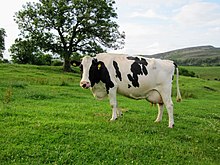 Holstein Friesian cows now dominate the global dairy industry. The Holstein-Friesian has the highest milk production of all breeds worldwide. | |
| Other names | Holstein cattle, Friesian cattle |
|---|---|
| State of origin | Netherlands, Frg, Denmark, Republic of austria, Switzerland, Belgium, France |
| Distribution | Worldwide |
| Apply | Dairy and meat (footing beefiness and roast beefiness) |
| Traits | |
| Weight |
|
| Acme |
|
| Coat | Black and white patched coat (occasionally red and white). |
| Horn condition | Horned, mainly dehorned as calves |
| Notes | |
| Originally a dual-purpose breed, used for both dairy and beefiness. | |
| |
Holstein Friesians (often shortened to Holsteins in N America, while the term Friesians is often used in the UK and Republic of ireland) are a breed of dairy cattle that originated in the Dutch provinces of Due north Kingdom of the netherlands and Friesland, and Schleswig-Holstein in Northern Germany. They are known as the world's highest-producing dairy animals.
Dutch and German breeders developed the brood with the goal of producing animals that could virtually efficiently use grass, the expanse's nearly arable resource, as their nutrient. Over the centuries, the result was a high-producing, black-and-white dairy cow.
The Holstein-Friesian is the nearly widespread cattle brood in the world; it is found in more than 150 countries.[ane] With the growth of the New World, a need for milk developed in Due north America and S America, and dairy breeders in those regions at first imported their livestock from kingdom of the netherlands. All the same, afterward about eight,800 Friesians (black pied German cows) had been imported, Europe stopped exporting dairy animals due to disease problems.[2]
Today, the brood is used for milk in the due north of Europe, and for meat in the due south of Europe. Afterward 1945, European cattle convenance and dairy products became increasingly confined to certain regions due to the development of national infrastructure. This change led to the demand to designate some animals for dairy production and others for beef product. (Previously, milk and beef had been produced from dual-purpose animals.) Today, more than than 80% of dairy production takes place north of the line between Bordeaux and Venice, and more than than 60% of the cattle in Europe are found at that place besides. Today'due south European breeds, national derivatives of the Dutch Friesian, accept become very different animals from those adult by breeders in the United states of america, who utilize Holsteins only for dairy production.
As a result, breeders take imported specialized dairy Holsteins from the United States to cross-breed them with European black-and-whites. Today, the term "Holstein" is used to draw Due north or South American stock and the use of that stock in Europe, especially in Northern Europe. "Friesian" is used to describe animals of traditional European ancestry that are bred for both dairy and beef use. Crosses betwixt the 2 are described equally "Holstein-Friesian".
Breed characteristics [edit]

Holsteins have distinctive markings, normally black and white or carmine and white in colour, typically exhibiting piebald patterns.[iii] On rare occasions, some have both black and cherry colouring with white. Carmine cistron causes this unique colouring. 'Blue' is also a known colour. This colour is produced past white hairs mixed with the black hairs giving the cow a bluish tint. This colouring is too known as 'blue roan' in some farm circles. They are famed for their high dairy production, averaging 22,530 pounds (10,220 kg) of milk per twelvemonth. Of this milk, 858 pounds (iii.7%) are butterfat and 719 pounds (iii.one%) are protein.[4]
A healthy dogie weighs 40 to fifty kg (75–110 lb) or more at birth. A mature Holstein cow typically weighs 680–770 kg (1500–1700 lb), and stands 145–165 cm (58–65 in) tall at the shoulder. Holstein heifers should be bred by 11 to xiv months of age, when they weigh 317–340 kg (700–750 lb) or 55% of adult weight. Mostly, breeders plan for Holstein heifers to calve for the first fourth dimension betwixt 21 and 24 months of age and 80% of adult bodyweight. The gestation period is most nine and a half months.[5]
History [edit]
Near 100 BC, a displaced group of people from Hesse migrated with their cattle to the shores of the North Sea nigh the Frisii tribe, occupying the island of Batavia, between the Rhine, Maas, and Waal. Historical records suggest these cattle were black, and the Friesian cattle at this fourth dimension were "pure white and light coloured". Crossbreeding may have led to the foundation of the present Holstein-Friesian breed, equally the cattle of these two tribes from and so are described identically in historical records.
The portion of the country bordering on the N Bounding main, called Frisia, was situated within the provinces of Northward The netherlands, Friesland and Groningen, and in Federal republic of germany to the River Ems. The people were known for their intendance and breeding of cattle. The Frisii, preferring pastoral pursuits to warfare, paid a tax of ox hides and ox horns to the Roman regime, whereas the Batavii furnished soldiers and officers to the Roman ground forces; these fought successfully in the diverse Roman wars. The Frisii bred the same strain of cattle unadulterated for 2,000 years, except from accidental circumstances. In 1282 Ad, floods produced the Zuiderzee, a formed trunk of water that had the result of separating the cattle breeders of the mod solar day Frisians into 2 groups. The western group occupied West Friesland, at present function of Due north Kingdom of the netherlands; the eastern occupied the present provinces of Friesland and Groningen, likewise in the Netherlands.
The rich polder land in kingdom of the netherlands is unsurpassed for the production of grass, cattle, and dairy products. Between the 13th and 16th centuries, the production of butter and cheese was enormous. Historic records draw heavy beef cattle, weighing from 2,600 to 3,000 pounds each.
The breeders had the goal of producing every bit much milk and beefiness as possible from the same animal. The selection, breeding and feeding have been carried out with huge success. Inbreeding was non tolerated, and (distinct) families never arose, although differences in soil in dissimilar localities produced different sizes and variations.[6]
United Kingdom [edit]
Up to the 18th century, the British Isles imported Dutch cattle, using them as the basis of several breeds in England and Scotland. The eminent David Low recorded, "the Dutch brood was especially established in the district of Holderness, on the north side of the Humber; n through the plains of Yorkshire. The finest dairy cattle in England...", of Holderness in 1840 withal retained the distinct traces of their Dutch origin.[ citation needed ]
Farther north in the Tees surface area, farmers imported continental cattle from the Netherlands and German territories on the Elbe. Depression wrote, "Of the precise extent of these early on importations we are imperfectly informed, but that they exercised a groovy influence on the native stock appears from this circumstance, that the brood formed by the mixture became familiarly known as the Dutch or Holstein breed".[ citation needed ]
Holstein-Friesians were found throughout the rich lowlands of the Netherlands, northwestern provinces of Germany, Kingdom of belgium and northern French republic. The breed did non go established in Bang-up Great britain at the fourth dimension, nor was information technology used in the islands of Jersey or of Guernsey, which bred their own special cattle named after the islands. Their laws prohibited using imports from the continent for convenance purposes.[vi] After Earth War II, breeders on the islands needed to restore their breeds, which had been severely reduced during the state of war, and imported virtually 200 animals. Canadian breeders sent a gift of three yearling bulls to help establish the breed.
The pure Holstein Breed Society was started in 1946 in Great britain, following the British Friesian Cattle Society. The brood was adult slowly upward to the 1970s, subsequently which there was an explosion in its popularity, and additional animals were imported. More than recently, the two societies merged in 1999 to establish Holstein UK.[7]
Numbers [edit]
Records on 1 April 2005 from Nomenclature for Units of Territorial Statistics level one show Holstein influence actualization in 61% of all three.47 million dairy cattle in the Britain:[8]
- Holstein-Friesian (Friesian with more than 12.v% and less than 87.v% of Holstein blood): 1,765,000 (51%)
- Friesian (more 87.five% Friesian blood): ane,079,000 (31%)
- Holstein (more than 87.five% of Holstein blood): 254,000 (7%)
- Holstein-Friesian cross (any of the above crossed with other breeds): 101,000 (3%)
- Other dairy breeds: 278,000 (seven%)
The above statistics are for all dairy animals possessing passports at the time of the survey, i.due east. including young stock. DEFRA lists just over 2 million adult dairy cattle in the Britain.[9]
Definition [edit]
Holstein in this instance, and indeed in all modernistic word, refers to animals traced from Due north American bloodlines, while Friesian refers to indigenous European black and white cattle.
Criteria for inclusion in the Supplementary Register (i.e. not purebred) of the Holstein UK herd book are:
Form A is for a typical representative of the Holstein or Friesian breed, as to type, size and constitution, with no obvious signs of crossbreeding, or be proved from its convenance records to contain betwixt fifty% and 74.9% Holstein genes or Friesian genes. If the breeding records show that one parent is of a breed other than Holstein-Friesian, Holstein, or Friesian, then such parent must be a purebred animate being fully registered in a herd volume of a dairy breed social club recognized by the Society.
Class B is for a calf by a balderdash registered or dual registered in the Herd Book or in the Supplementary Register and out of a foundation cow or heifer registered in Form A or B of the Supplementary Annals and containing betwixt 75% and 87.4% Holstein genes or Frisian genes.
For inclusion in the Pure (Holstein or Friesian) herd volume, a heifer or bull calf from a cow or heifer in Class B of the Supplementary Annals and by a balderdash registered or dual registered in the Herd Volume or the Supplementary Register, and containing 87.5% or more than Holstein genes or Western frisian genes will exist eligible to have its entry registered in the Herd Book.[10]
Production [edit]
The breed currently averages seven,655 litres/twelvemonth throughout three.2 lactations with pedigree animals averaging eight,125 litres/twelvemonth over an average of iii.43 lactations.[7] Past adding, lifetime production therefore stands at effectually 26,000 litres.
United States [edit]
History [edit]

"Trina", pictured with Karl Merrill in 1910
Black and white cattle from Europe were introduced into the Us from 1621 to 1664. The eastern role of New Netherland (modern day New York and Connecticut), where many Dutch farmers settled along the Hudson and Mohawk River valleys. They probably brought cattle with them from their native state and crossed them with cattle purchased in the colony. For many years afterwards, the cattle hither were chosen Dutch cattle and were renowned for their milking qualities.
The first recorded imports were more than than 100 years later, consisting of half-dozen cows and two bulls. These were sent in 1795 by the Holland Land Company, which then endemic large tracts in New York, to their amanuensis, Mr. John Lincklaen of Cazenovia. A settler described them thus, "the cows were of the size of oxen, their colors clear black and white in large patches; very handsome".
In 1810, a bull and 2 cows were imported by the Hon. William Jarvis for his farm at Wethersfield, Vermont. About the year 1825, another importation was made by Herman Le Roy, a part of which was sent into the Genesee River valley. The residue were kept most New York City. Still after, an importation was made into Delaware. No records were kept of the descendants of these cattle. Their blood was mingled and lost in that of the native cattle.
The first permanent introduction of this breed was due to the perseverance of Hon. Winthrop West. Chenery, of Belmont, Massachusetts. The animals of his first two importations, and their offspring, were destroyed by the regime in Massachusetts because of a contagious illness. He made a third importation in 1861. This was followed in 1867 by an importation for the Hon. Gerrit S. Miller, of Peterboro, New York, fabricated by his brother, Dudley Miller, who had been attending the noted agricultural school at Eldena (Königlich Preußische Staats- und landwirthschaftliche Akademie zu Greifswald und Eldena; the latter today a locality of the former), Prussia, where this brood was highly regarded. These ii importations, by Hon. William A. Russell, of Lawrence, Mass., and iii animals from East Friesland, imported by Gen. William S. Tilton of the National Armed services Asylum, Togus, Maine, formed the nucleus of the Holstein Herd Volume.[6]
The Trina Holstein breed was established past the Merrill farming family unit in Maine in the early on 20th century, begun by "Trina Redstone Marvel" (or "One-time Trina") and connected at Wilsondale Farm in Grey, Maine.[11] Trina was traced back sixteen generations to 1 of the start cows imported into the United States from New Netherland.[12] There are 30 generations of Trina Holstein offspring today.[eleven]
Later about eight,800 Holsteins had been imported, a cattle disease bankrupt out in Europe and importation ceased.
In the late 19th century, at that place was plenty interest among Friesian breeders to course associations to tape pedigrees and maintain herd books. These associations merged in 1885, to constitute the Holstein-Friesian Association of America. In 1994, the name was changed to Holstein Association USA, Inc.[four]
Production [edit]
The 2008 boilerplate actual product for all U.s. Holstein herds that were enrolled in product-testing programs and eligible for genetic evaluations was 23,022 pounds (ten,443 kg) of milk, 840 pounds (380 kg) of butterfat, and 709 pounds (322 kg) of protein per year.[13] Total lifetime productivity can be inferred from the average lifetime of U.s. cows. This has been decreasing regularly in recent years and at present stands at effectually 2.75 lactations, which when multiplied by average lactation yield in a higher place gives around 61,729 pounds (28,000 kg) of milk.[14]
The current national Holstein milk production leader is Bur-Wall Buckeye Gigi EX-94 3E, which produced 74,650 pounds (33,860 kg) of milk in 365 days, completing her record in 2016.[15]
The considerable advantage, compared to the United kingdom, for instance, can be explained by several factors:
- Use of milk production hormone, recombinant bST: A report in February 1999 determined the "response to bST over a 305-mean solar day lactation equaled 894 kg of milk, 27 kg of fat, and 31 kg of protein".[xvi] Monsanto Company estimates a effigy of most 1.5 million of ix million dairy cows are being treated with rBST, or about 17% of cows nationally.[17]
- Greater use of three-times-per-day milking: In a report performed in Florida betwixt 1984 and 1992 using 4293 Holstein lactation records from viii herds, 48% of cows were milked iii times a solar day. The practice was responsible for an actress 17.3% milk, 12.iii% fat, and eight.8% poly peptide.[eighteen] Three-times-a-day milking has become a common in recent years. Twice-a-24-hour interval milking is the most mutual milking schedule of dairy cattle. In Europe, Commonwealth of australia, and New Zealand, milking at ten- to 14-hr intervals is mutual.[xix]
- College moo-cow potential (100% Holstein herds): European Friesian types traditionally had lower production performances than their Northward American Holstein counterparts. Despite Holstein influence over the final fifty years, a large genetic trace of these cattle is still present.
- Greater employ of total mixed ration (TMR) feeding systems: TMR systems continue to expand in use on dairy farms. A 1993 Hoard's Dairyman survey reported 29.2% of surveyed U.s. dairy farms had adopted this system of feeding dairy cows. A 1991 Illinois dairy survey institute 26% of Illinois dairy farmers used TMR rations with 300 kg more milk per cow compared to other feeding systems.[xx] The American type of functioning (North and South America) is characterised by large, loose-housing operations, TMR feeding, and relatively many employees. However, dairy farms in the northeast United states of america and parts of Canada differ from the typical American operation. There, many smaller family farms with either loose-housing or stanchion barns are found. These operations are quite like to the European blazon, which is characterised by relatively minor operations where each moo-cow is fed and treated individually.[21]
Genetics [edit]
The gilt historic period of Friesian breeding occurred during the concluding 50 years, greatly helped lately by embryo transfer techniques, which permitted a huge multiplication of bulls entering progeny testing of elite, bull-mother cows.
Friesian bull, Osborndale Ivanhoe, b. 1952, brought stature, angularity, good udder conformation, and feet and leg conformation, but his daughters lacked strength and depth. His descendants included:
- Round Oak Rag Apple tree Elevation, b. 1965, often abbreviated RORA Summit, was another top-notch balderdash. He sired over seventy,000 Holstein cattle, with descendants numbering over 5 1000000; Elevation was named Bull of the Century by Holstein International Association in 1999.[22] Summit was the consequence of a cantankerous of Tidy Burke Elevation existence used on 1 of the best ever Ivanhoe daughters, Round Oak Ivanhoe Eve. He was unsurpassed at the time for blazon and production.
- Penstate Ivanhoe Star, b. 1963, sired daughters with similar stature and dairy traits as the Ivanhoes, but with higher product. He as well notably sired Carlin-Chiliad Ivanhoe Bell, the great production bull of the 80s, known also for practiced udders, feet and legs. A present-day genetic disorder, complex vertebral malformation, has been traced to Carlin-M Ivanhoe Bong and Penstate Ivanhoe Star.
- Hilltop Apollo Ivanhoe, b. 1960, sire of Whittier Farms Apollo Rocket, b. 1967, was the highest milk production balderdash of the 1970s, and Wayne Spring Fond Apollo, b. 1970, was the commencement bull always to have a milk manual alphabetize of over 2,000 M and have a positive type index. "Wayne" had a very famous girl, To-Mar Wayne Hay, that was dam of the great To-Mar Blackstar, b. 1983.
Cloning [edit]
Starbuck (2)II, clone of the famous CIAQR sire Hanoverhill Starbuck, was born on 7 September 2000 in Saint-Hyacinthe. The clone is a result of the combined efforts of CIAQ, Fifty'Alliance Boviteq Inc, and the Faculté de médecine vétérinaire de l'Université de Montréal. The cloned dogie was built-in 21 years and v months after Starbuck's ain nativity date and just nether 2 years later his death (17 September 1998). The calf weighed 54.ii kg at nascence and showed the aforementioned vital signs as calves produced from regular AI or ET. Starbuck II is derived from frozen fibroblast cells, recovered one month before the expiry of Starbuck.[23]
The Semex Alliance also cloned other bulls, such as Hartline Titanic, Canyon-Cakewalk Allen, Ladino-Park Talent, and Braedale Goldwyn.
A huge controversy in the UK in January 2007 linked the cloning visitor Smiddiehill and Humphreston Farm owned past father-and-son team Michael and Oliver Eaton (also owners of the large, Birmingham-based stone product business, BS Eaton) with a dogie that was cloned from a cow in Canada. Despite their efforts to block the farm from view of the press, news cameras circulate this as breaking news among many of the state's top news stations. Since then, this dogie had been rumored to have been put downward to protect the owners, the Eatons, from invasions of the press.[24]
British Friesian cattle [edit]
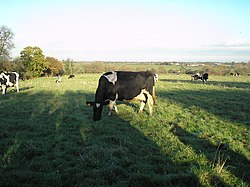
A British Friesian cow grazing
While interest in increasing production through indexing and lifetime turn a profit scores had a huge increment in Holstein bloodlines in the United kingdom of great britain and northern ireland, proponents of the traditional British Friesian did not see things that way, and maintain these criteria do not reverberate the truthful profitability or the product of the Friesian cow.
Friesian breeders say modernistic conditions in the UK, similar to the 1950s through to the 1980s, with depression milk cost and the demand for extensive, low-cost systems for many farmers, may ultimately cause producers to re-examine the attributes of the British Friesian.
This animal came to boss the UK dairy cow population during these years, with exports of stock and semen to many countries throughout the world. Although the idea of "dual-purpose" animals has arguably get outmoded, the fact remains that the Friesian is eminently suitable for many farms, particularly where grazing is a main feature of the system.
Proponents fence that Friesians last for more lactations through more robust conformation, thus spreading depreciation costs. An added advantage of income from the male dogie exists, which tin be placed into barley beef systems (finishing from 11 months) or steers taken on to finish at two years, on a inexpensive organisation of grass and silage. Very respectable grades can be obtained, commensurate with beef breeds, thereby providing extra income for the farm.
Such all-encompassing, depression-cost systems may imply lower veterinary costs, through good fertility, resistance to lameness, and a tendency to higher protein percentage, and, therefore, higher milk price. An 800-kg Holstein has a higher daily maintenance energy requirement than the 650-kg Friesian.
Friesians have also been disadvantaged through the comparison of their type to a Holstein base. A carve up "index" be composed to greater has been suggested to reflect the aspects of maintenance for bodyweight, protein percent, longevity, and calf value. National Milk Records figures propose highest yields are achieved between the fifth and seventh lactations; if so, this is particularly then for Friesians, with a greater lift for mature cows, and sustained over more than lactations. Nevertheless, production index only takes the first five lactations into account. British Friesian convenance has certainly not stood all the same, and through studied evaluation, substantial gains in yield accept been achieved without the loss of type.
History [edit]
Friesians were imported into the east coast ports of England and Scotland, from the lush pastures of North Kingdom of the netherlands, during the 19th century until alive cattle importations were stopped in 1892, as a precaution against endemic foot and mouth disease on the Continent. They were so few in number, they were not included in the 1908 census.
In 1909, though, the society was formed as the British Holstein Cattle Society, soon to be inverse to British Holstein Friesian Society and, by 1918, to the British Friesian Cattle Society.
The Livestock Periodical of 1900 referred to both the "exceptionally good" and "remarkably inferior" Dutch cattle. The Dutch cow was also considered to require more than quality forage and need more looking later than some English cattle that could easily be out-wintered.
In an era of agricultural depression, brood societies notably had flourished, as a valuable export trade adult for traditional British breeds of cattle. At the end of 1912, the herd book noted 1,000 males and half-dozen,000 females, the stock which originally formed the foundation of the breed in England and Scotland. Entry from and so until 1921, when grading upwards was introduced, was by pedigree simply.
No other Friesian cattle were imported until the official importation of 1914, which included several virtually descendants of the renowned dairy bull Ceres 4497 F.R.S. These cattle were successful in establishing the Friesian equally an eminent, long-lived dairy breed in Great britain. This role was connected in the 1922 importation from South Africa through Terling Marthus and Terling Collona, which were also virtually descendants of Ceres 4497.
The 1936 importation from the Netherlands introduced a more dual-purpose type of fauna, the Dutch having moved away from the Ceres line in the concurrently.
The 1950 importation has a lesser influence on the breed today than the previous importations, although various Adema sons were used successfully in some herds.
The Friesian enjoyed great expansion in the 1950s, through to the 80s, until the increased Holstein influence on the national herd in the 1990s[ citation needed ]; a trend which is being questioned past some commercial dairy farmers in the harsh dairying climate that prevails today, with the need to exploit grazing potential to the fullest.
Friesian semen is once again being exported to countries with grass-based systems of milk production. The mod Friesian is pre-eminently a grazing animal, well able to sustain itself over many lactations, on both depression-lying and upland grasslands, being developed by selective breeding over the last 100 years. Some outstanding examples of the breed take 12 to 15 lactations to their credit, emphasising their inherent natural fecundity. In response to demand, protein percentages have been raised across the breed, and herd protein levels of 3.4% to 3.v% are non uncommon.
Whilst the British Friesian is starting time and foremost a dairy breed, giving high lifetime yields of quality milk from dwelling house-produced feeds, by a happy coincidence, surplus male person animals are highly regarded equally producers of high quality, lean meat, whether crossed with a beefiness brood or non. Beef-cross heifers accept long been sought after equally ideal suckler cow replacements.
Although understanding the need to change the society's name to include the word Holstein in 1988, British Friesian enthusiasts are less than happy now that the word Friesian has been removed from the name. With the history of the breed spanning 100 years, the British Friesian cow is standing to show her worth. The general robustness and proven fertility provide an ideal black and white cross for Holstein breeders seeking these attributes.
The disposal of male blackness and white calves continues to receive media attending, and would announced to be a waste of a valuable resource. One of the great strengths of the British Friesian is the ability of the male dogie to stop and class satisfactorily, either in intensive systems, or as steers, extensively. This latter system may become increasingly popular due to the prohibitive increase in grain prices. The robustness of the British Friesian and its suitability to grazing and forage systems is well known.
Compared to the Holsteins, the Friesians:
- Calve more frequently
- Calve more frequently in their lifetimes
- Need fewer replacements
- Provide valuable male calves
- Have lower cell counts
- Have higher fat and poly peptide percentages[25]
Polled Holsteins [edit]
The first polled Holstein was identified in the Us in 1889. Polled Holsteins accept the dominant polled gene which makes them naturally hornless. The polled gene has historically had a very low factor frequency in the Holstein breed. Notwithstanding, with fauna welfare concerns surrounding the practice of dehorning, the interest in polled genetics is growing rapidly.[26]
Cerise and white Holsteins [edit]


The expression of red colour replacing the black in Holsteins is a function of a recessive cistron.[27] Assuming the allele 'B' stands for the dominant black and 'b' for the recessive red, cattle with the paired genes 'BB', 'Bb', or 'bB' would exist blackness and white, while 'bb' cattle would be red and white.
History [edit]

Earlier 13th-century records show cattle of "cleaved" colours entered the Netherlands from Central Europe. Nigh foundation stock in the US were imported between 1869 and 1885. A group of early breeders decreed that animals of any colour other than black and white would not be accepted in the herd book, and that the breed would be known as Holsteins. There were objections, proverb that quality and not colour should be the aim, and that the cattle should be chosen "Dutch" rather than Holsteins.
Merely a small-scale number of carriers were identified over the hundred-year span from the early importations until they were accepted into the Canadian and American herd books in 1969 and 1970, respectively. Almost of the early on accounts of red calves being built-in to black and white parents were never documented. A few stories of "reds" born to elite parents persist over time, equally there is a tendency to credit the ancestor with the highest (closest) relationship to a red-carrier brute every bit the i that transmitted the trait, whereas sometimes information technology is the other parental line that has passed it on, even though the ancestor responsible may have entered the full-blooded several generations before.
In 1952, a sire in an artificial insemination (AI) unit in the US was a carrier of red coat colour. Although the AI unit reported the condition and advised breeders as to its mode of inheritance, almost a third of the breeding unit of measurement's Holstein inseminations that year were to that red-carrier bull. That twelvemonth, American AI units had used 67 cherry-red-gene bulls that had sired 8250 registered progeny. In spite of this, whatsoever alter to the colour marker rules was rejected.
The Cerise and White Dairy Cattle Association (RWDCA) began registry procedures in 1964 in the Usa.[28] Its offset members were Milking Shorthorn breeders, who wanted a dairy registry for the cattle they had bred in prior years, including some scarlet and white Holsteins. When Milking Shorthorn breeders were looking for potential outcrossing individuals to amend milk production, red and white Holsteins came into the picture show, since the red color factor is the same for both breeds. The RWDCA had adopted an "open herd book" policy, and the Red and White Holstein became the major player.
The ruby-red trait was thus able to survive the attempts to eradicate it that came from all sides of the Holstein industry. It was inevitable that even when a red calf was culled, the herd owner rarely did anything to remove the dam from his herd and only hoped she would not have another carmine calf. Many red calves, born in both countries prior to the 1970s, were quietly disposed of, with a view to preserving the acceptance of their elite pedigrees.
Also, thousands of Holsteins were imported from Canada each year, and many were carriers. More than 14,000 Holsteins were exported to the United States in 1964 and again in 1965. This was at a fourth dimension when both countries were debating the "red question". While the United States was trying to eliminate the cherry trait, the Canadian imports simply counterbalanced the U.s.a. effort to reduce its incidence.
Canada'due south number one cherry-carrier sire in the 1940s was A.B.C. Reflection Sovereign.[29] His sons and grandsons in the 1950s and '60s spread the cerise gene throughout Canada and increased its frequency in the United states. Three other big names siring Red and Whites in the United States were Rosafe Citation R, Roeland Reflection Sovereign, and Chambric A.B.C. The red trait was readily available in Canadian Holstein genetics.
Early on, there was criticism of the policy of the Canadian AI units to remove bulls found to deport red. A number of superior bulls were slaughtered or exported. The studs were simply supporting the Canadian policy to prevent the intensification of the cerise recessive in the breed. The phrase "carries the red factor" had to exist included in the description, and excessive promotion of unproven red-gene bulls was discouraged. They later added the aim of permitting intelligent breeders to apply any red-carrier sire that had an outstanding proof for production and type.
Information technology became obvious that AI was the master manner of finding out which bulls were red carriers. Prior to AI, few red-carrier sires were uncovered because their service was express to one or a few herds. Such herds often had no carrier females, and there was merely a 25% chance that a carrier bull mated to a carrier female person would produce a scarlet calf. If a red and white dogie were dropped, information technology was often concealed and quietly removed from the herd.
In 1964, the netherlands Herd Book Order indicated a breakdown of 71% Blackness and White Friesian and 28% Red and Whites. A herd book that accustomed Red and Whites had already been established in the United states of america. A split up herd book for Canadian Red and Whites was and so established, following which Crimson and Whites became acceptable to the major Canadian (export) markets. The sales ring began to constitute interest in the new breed.
The US Holstein-Friesian Association and its membership worked diligently from its early days until 1970 to eliminate the scarlet trait from the registered population. All the same, once the door was open, red and whites began to announced in some of the more aristocracy herds. The rush to go the best of Canadian breeding even prior to the opening of the herd book brought red calves to many dairymen who had never even seen one.
Canadian Red and Whites became eligible for registration in the herd book on July 1, 1969, through an alternate registry. Red and Whites were to exist listed with the suffix –RED and Black and Whites with ineligible markings would be registered with the suffix –ALT. Both groups and their progeny would be listed only in the Alternate volume and the suffixes had to be part of the name. In the Canadian herd books, all –Alt and -Red animals were listed in the regular herd book in registration number guild and were identified with an A in front of their numbers. The Alternates were split in name but. The A in front of the registration number was discontinued in 1976 and the –Alt suffix was dropped in 1980, but –Scarlet was connected. Information technology did not bar the registration of animals whose hair turned from red to blackness.
The U.s. Holstein Association decided not to accept a split up herd book for ruddy and whites and off-color animals. The suffixes of –Red and –OC would be used, and numbering would be consecutive. The outset cherry and white Holsteins were recorded with an R in front of their numbers. 212 males and 1191 females were recorded in the initial grouping of red registrations. Red and Whites registered in the Canadian herd book numbered 281 in 1969 and 243 in 1970.
An American Breeders Service advertizing in the Canadian Holstein Journal in 1974 on Hanover-Hill Triple Threat mentioned i of several colour variants that were not true red. Its existence was undoubtedly common knowledge amidst breeders in both countries, simply until that time, it had not been mentioned in print. Calves were built-in red and white and registered equally such, only over the first six months of age turned blackness or generally blackness with some cherry-red hairs down the backline, around the muzzle and at the poll. The hair glaze colour alter became known equally Black/Cherry-red and sometimes every bit Telstar/Red, since the condition appeared in calves sired by Roybrook Telstar. Telstar was the sire of Triple Threat, only null about this had hitherto been in print about Telstar, which was by then over 10 years old.
Black/Reds were frequently discriminated against when sold and were barred from Red and White-sponsored shows. In 1984, Holstein Canada considered recoding B/R bulls that had ever been coded only equally cherry-red carriers, a designation that was not acceptable to all buyers. The breed agreed to alter subsequently checking with other breed associations and with the AI industry. In 1987, Holstein Canada and the Canadian AI industry modified their coding procedures to distinguish between Black/Cerise and truthful red colour patterns for bulls. Holstein Canada dropped the suffix Red equally a part of the name in 1990, but continued to carry information technology every bit function of the birth date and other codes field.
.
Notable Holsteins [edit]

- Pauline Wayne, US president Taft's "pet" cow[ citation needed ]
- RORA Elevation, a prize-winning bull
- Pawnee Farm Arlinda Master, a balderdash with bang-up genes for milk production; however, he besides introduced a lethal cistron into the population[30]
- Belle Sarcastic, "unofficial mascot" of Michigan Country University Archives and Historical Collections[31]
- Kian (1997-2013), the first crimson Holstein bull whose semen has sold more ane one thousand thousand units worldwide[32]
- Osborndale Ivanhoe (1952-1970), Holstein bull owned past Frances Osborne Kellogg and mated 100,187 times and whose semen was shipped all over the world.[33]
- Toystory (2001-2014), Holstein bull whose semen has sold more than 2.4 million units worldwide and has been estimated to accept sired over 500,000 offspring[34]
- Knickers, an extremely large bull from Western Australia, which was making worldwide headlines in November 2018 for being too large to exist processed at the local abattoirs.[35] [36] [37]
References [edit]
- ^ "Gateway to dairy production and products". FAO (fao.org) . Retrieved 20 July 2020.
- ^ CIV, France, a tradition of animal husbandry. Animal husbandry and environment Archived 2013-04-12 at the Wayback Automobile. Civ-viande.org. Retrieved on 2011-11-03.
- ^ Fontanesi, L.; Scotti, E.; Russo, V. (15 Sep 2011). "Haplotype variability in the bovine MITF cistron and association with piebaldism in Holstein and Simmental cattle breeds". Brute Genetics. 43 (3): 250–256. doi:10.1111/j.1365-2052.2011.02242.x. ISSN 1365-2052. PMID 22486495.
- ^ a b Holstein Association USA, The Globe'due south Largest Dairy Breed Association. Holsteinusa.com. Retrieved on 2011-11-03.
- ^ Breeds of Livestock – Holstein Cattle. Ansi.okstate.edu (2000-02-23). Retrieved on 2011-11-03.
- ^ a b c Core Historical Literature of Agriculture. Chla.library.cornell.edu. Retrieved on 2011-11-03.
- ^ a b A Brief history of the Holstein Breed, Holstein UK
- ^ Most common breeds of cattle in GB (Nuts 1 areas) on 01 April 2005 Archived Jan two, 2007, at the Wayback Machine
- ^ National statistics reports. Department for Environment, Food and Rural Affairs (DEFRA). 25 March 2008
- ^ Bye-Laws. Holstein UK
- ^ a b "Wilsondale Subcontract celebrates fifty years with friends and family" - Lewiston Sun Journal, June 19, 2011
- ^ "Mike Wilson of Wilsondale Farm Obituary" – Cowsmopolitan, June fifteen, 2021
- ^ History of the Holstein Breed. Holsteinusa.com. Retrieved on 2011-11-03.
- ^ H. Duane Norman, E. Hare, and J.R. Wright Historical examination of culling of dairy cows from herds in the Us (PPT file). Animal Improvement Programs Laboratory Agricultural Research Service, USDA
- ^ "Gigi The Cow Bankrupt The Milk Product Record. Is That Bad For Cows?". NPR.org . Retrieved 2017-08-ten .
- ^ Bauman, D. Eastward.; Everett, R. W.; Weiland, W. H. & Collier, R. J. (1999). "Production Responses to Bovine Somatotropin in Northeast Dairy Herds". Journal of Dairy Science. 82 (12): 2564–2573. doi:x.3168/jds.S0022-0302(99)75511-6. PMID 10629802.
- ^ 2016 in America most dairy markets are non supplemented, the use of rBST in dairy cattle is in rapid decline since 2006. The patent owner of rBST is Elanco supp rBST Use Among U.South. Dairy Farmers: A Comparative Analysis from six States Archived March 8, 2008, at the Wayback Motorcar
- ^ Campos, MS; Wilcox, CJ; Head, HH; Webb, DW; Hayen, J (1994). "Effects on Production of Milking Three Times Daily on Start Lactation Holsteins and Jerseys in Florida". Journal of Dairy Science. 77 (3): 770–three. doi:ten.3168/jds.S0022-0302(94)77011-9. PMID 8169285.
- ^ Armstrong, Dennis V. "Milking Frequency". Dairy Biz. Archived from the original on February 7, 2008.
- ^ A Cost-Benefit Analysis of Changing to a TMR Feeding System. Wcds.afns.ualberta.ca. Retrieved on 2011-11-03.
- ^ Management of the dairy cow. world wide web.delaval.co.uk
- ^ Round Oak Rag Apple Elevation Archived October six, 2007, at the Wayback Auto
- ^ "Starbuck". Archived from the original on vii September 2008.
- ^ Red AND WHITE HOLSTEIN HISTORY. das.psu.edu
- ^ "Increase in Popularity". Britishfriesian.co.great britain. British Friesian Breeders Order. Archived from the original on 18 October 2015. Retrieved 2011-eleven-03 .
- ^ "Dairy". Penn State Extension.
- ^ livestock equipment for the profitable farm. AgSelect.com. Retrieved on 2011-xi-03.
- ^ "Red and White Dairy Cattle Association". Archived from the original on 27 Baronial 2018.
- ^ "The Genetic Genius of Darwin, Mendel and Hunt – Genetic Transmission and the Holstein Cow :: The Bullvine - The Dairy Data You lot Want To Know When You Demand Information technology". www.thebullvine.com.
- ^ Vicious, Andy (18 October 2016). "1 prize bull acquired 500,000 miscarried calves". Futurity . Retrieved 7 April 2021.
- ^ "Belle Sarcastic — MSU's Famous Dairy Cow" (PDF). MSU Archives & Historical Collections. Michigan Country University.
- ^ "Rotbuntbulle Kian ist tot". topagrar.com. June 28, 2013. Retrieved December 19, 2014.
- ^ Eddy, Roger (1970-04-01). "Osborndale Ivanhoe Lies A-Mold'band in the Grave". Esquire . Retrieved 2020-09-09 .
- ^ Peters, Marking; Brat, Ilan (2015-01-14). "A Breeder Apart: Farmers Say Goodbye to the Bull Who Sired 500,000 Offspring". Wall Street Journal.
- ^ Jacqueline Lynch, Tyne Logan: Knickers the steer, 1 of the globe's biggest steers, avoids the abattoir thanks to his size. ABC News, 29 Oct 2018
- ^ Daniel Victor: Wow, That Steer Is Actually Big. New York Times, 28 November 2018
- ^ Gavin Butler: Commonwealth of australia's Biggest Cow Is Literally Too Fatty to Be Killed. Vice, 28 Nov 2018
Other sources [edit]
- Depression, David (1845) On the Domesticated Animals of the British Islands: Comprehending the Natural and Economic History of Species and Varieties; the Description of the Backdrop of External Grade; and Observations on the Principles and Practise of Breeding, Longman, Chocolate-brown, Green, & Longmans.
External links [edit]
- Ontario Plaques – Holstein Friesian Cattle in Ontario
- World Holstein-Friesian Federation
- Holstein Association United states

How Many Registered Holsteins Are There,
Source: https://en.wikipedia.org/wiki/Holstein_Friesian_cattle
Posted by: kimbeesic.blogspot.com
0 Response to "How Many Registered Holsteins Are There"
Post a Comment